
Should I Buy Aluminum or Stainless Steel Coffee Filters? Detailed Comparison From A–Z
The coffee filter is a familiar tool for those who love the taste of traditional Vietnamese coffee. However, when choosing to buy filters, many people wonder whether should they buy aluminum or stainless steel coffee filters to make delicious coffee, last long and be easy to clean.
Each type of filter has its own advantages. Aluminum filters are often popular due to their light weight, good heat transfer ability and traditional coffee making style. Meanwhile, stainless steel filters are of interest to many people because of the material's anti-corrosion properties, shiny appearance and long-term use if manufactured according to standards.
So how are aluminum and stainless steel coffee filters different? Let's learn with S54 Coffee to choose the right type of filter for your needs at home, in coffee shops or in large quantities.
1. Should you buy aluminum or stainless steel coffee filters?
If you prioritize light weight, traditional filter feel and reasonable cost, aluminum filters are a choice worth considering. If you prioritize anti-corrosion properties, shiny appearance and convenience during use, stainless steel filters may be more suitable.
However, it is impossible to conclude which filter is better based on the material alone. Processing quality, thickness, drainage hole design, fit of the lid and cleanability also significantly affect the usage experience.
In particular, coffee flavor also depends on the type of bean, roasting level, grinding level, amount of water and brewing technique. Therefore, choosing the right type of coffee and using the filter properly is as important as choosing the material.
2. Compare aluminum and stainless steel coffee filters
To make it easier to choose, you can refer to the comparison table below.
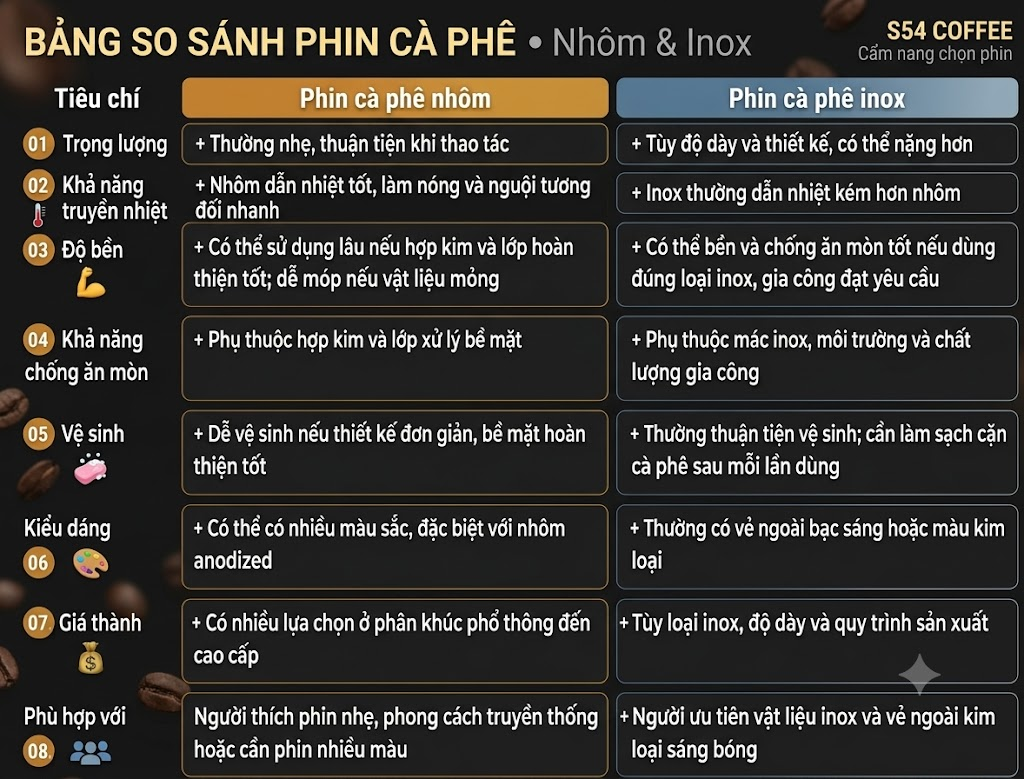
Note: This is a comparison based on common material properties variable. A high quality aluminum filter can be better than a poorly processed stainless steel filter, and vice versa.
3. Advantages and disadvantages of aluminum coffee filters
3.1. Advantages of aluminum filters
Light weight, easy to use
Aluminum has a lower density than stainless steel, so aluminum filters are often light, convenient to hold, place on cups and manipulate during the brewing process. This feature is useful for people who often make coffee or shops that need to use many filters a day.
Good heat transfer
Aluminum conducts heat well, helping heat transfer through the filter body faster than stainless steel in equivalent conditions. This may affect the temperature of the brewing system, but it does not mean that aluminum filters always produce better coffee. Water temperature, amount of coffee and brewing method are still important factors.
There are many choices of styles and colors
In addition to traditional aluminum filters, users can choose aluminum filters with surface treatment to create color. For coffee shops, multicolored products can also help synchronize tools with brand style.
Suitable for many needs
Aluminum filters come in many sizes, styles and prices. Users can choose the appropriate type to make coffee at home, serve customers at a shop or as a business gift.
3.2. Disadvantages of aluminum filters
The durability of aluminum filters depends on the type of alloy, thickness and quality of processing. Thin filters can be dented by strong impacts. Some products with poor surface finishes can also deteriorate more quickly if cleaned or stored incorrectly.
With colored aluminum filters, you should check the surface treatment method and safety information for food contact. Do not rely solely on color or advertising to evaluate quality.
4. Advantages and disadvantages of stainless steel coffee filters
4.1. Advantages of stainless steel filters
Good corrosion resistance when using the right type of stainless steel
Stainless steel is a commonly used material in many kitchen utensils. Corrosion resistance depends on the stainless steel grade, material composition, processing quality and usage environment.
When choosing stainless steel filters, you should prioritize products that clearly declare the type of material and have reliable origin information.
Shiny surface, modern design
Stainless steel filters often have a shiny appearance or have a characteristic metallic color. This design is suitable for people who like minimalist style and modern mixing spaces.
Can be used for a long time
A well-made stainless steel filter, used and cleaned properly can meet the needs of regular use. However, stainless steel does not mean that it is completely non-corrosive in all conditions.
4.2. Disadvantages of stainless steel filters
Compared to aluminum, stainless steel is often heavier if the products are of similar size and thickness. Stainless steel also conducts heat worse than aluminum, so the heat transfer characteristics of the filter body will be different.
The price of stainless steel filters depends on the steel grade, thickness and production process. Therefore, not all stainless steel filters are more expensive than aluminum filters, nor do high-priced products always have better quality.
In addition, stainless steel filters still need to be washed and dried after use. Coffee residue and dirt accumulated over time can affect hygiene as well as the using experience.
5. Do aluminum filters and stainless steel filters make delicious coffee differently?
This is a question that many people are interested in when choosing to buy filters.
In fact, it cannot be said that coffee brewed with aluminum filters is always better than stainless steel filters or vice versa. Filter material can affect the heat transfer process, but the taste of the finished product is influenced by many combined factors.

Factors affecting coffee flavor coffee
- Coffee bean quality:Coffee variety, growing region, processing method, and bean freshness all affect the flavor.
- Roast level: Light, medium, or dark roasted coffee will have different aroma and taste characteristics.
- Grind: Powder that is too fine can cause the water to flow slowly, while powder that is too coarse can cause the coffee to be under-extracted. enough.
- Coffee and water ratio: The right ratio helps control the strength and balance of the cup of coffee.
- Water temperature and extraction time: These two factors directly affect the compounds dissolved during the brewing process.
- Filter design: The size of the drainage hole, the screw cap and the fit between the parts can change the speed drip.
If you want to improve the flavor, you should control the above factors before assuming that the filter material is the main cause.
6. Should I buy aluminum or stainless steel coffee filters according to my needs?
6.1. For home use
If you often make coffee every morning and want a filter that is light and easy to handle, an aluminum filter is a choice worth considering. If you like shiny metal surfaces and prioritize stainless steel products, you can choose a good quality stainless steel filter.
In both cases, choose a filter size that matches the amount of coffee you usually brew. A filter that is too small or too large for the metering rate can make flow control difficult.
6.2. Used for coffee shops
For shops, in addition to the initial purchase price, you should consider durability, cleanability, uniformity between filters and convenience for continuous use.
If you need to buy many filters at the same time, check the actual sample before ordering a large quantity. You should test the fit of the lid, observe the drainage holes and test the mixture to evaluate the flow.
6.3. Buy filters as gifts or have your brand logo printed
If you need filters with your own color or want to synchronize your brewing equipment with your brand identity, colored aluminum filters may be a suitable option to explore.
Before placing an order, you should confirm the ability to print or engrave the logo, actual color, packaging specifications, production time and minimum order quantity. At the same time, information on materials and surface finishes used for products in contact with food should be requested.
7. Suggested anodized aluminum coffee filter S54 Coffee
If you are looking for aluminum filters with outstanding colors to use at home, serve customers at the shop or order in large quantities, you can refer to the anodized aluminum coffee filter S54 Coffee.
The product is introduced with color options such as black, yellow, orange and blue. The design includes the filter body, bottom plate, lid and clasp, serving the needs of making traditional filter coffee.
Some points you can learn more about when choosing a product:
- Color: You can choose a color that matches the shop's style or brand identity.
- Wholesale purchasing needs: Suitable for reference when you need to equip the shop with filters or order quantities. large.
- Logo engraving ability: Should confirm laser engraving plan, location and cost according to order requirements.
- Product information: Check specifications, materials, cleaning instructions and quality documents provided before ordering.
You can see product details at S54 Coffee's official page:
Wholesale color aluminum coffee filter S54: https://s54coffee.com/vi/san-pham/phin-ca-phe-nhom-mau-gia-si-s54
If buying for a shop or business business, please contact S54 Coffee to confirm current price, order quantity, delivery policy and logo engraving conditions before finalizing the order.
8. Experience in choosing to buy quality coffee filters
Whether choosing aluminum or stainless steel, you should check the following criteria before buying.
First, check the material and origin. Prioritize products with clear material information, reliable suppliers and documents related to food contact safety if necessary.
Second, check the drainage holes. The holes should be machined. evenly, without clogging or deformation. This is an important factor for a stable drip coffee flow.
Third, check the lid.The lid should fit well, be easy to operate, and not force the user to press too hard to keep the layer of coffee.
Fourth, consider the surface finish. Avoid products with sharp edges, peeling surfaces, metal burrs, or signs of sloppy workmanship.
Fifth, choose the size. appropriate size. Determine the amount of coffee you usually use each time to choose the corresponding filter, instead of just choosing based on shape or price.
Sixth, calculate the long-term cost of use. If buying for a shop, consider hygiene, durability, uniformity between products and the ability to replace when needed.
9. Frequently Asked Questions
Are aluminum coffee filters safe?
Aluminum filters can be suitable for coffee making purposes when manufactured from suitable materials, properly finished and used according to the instructions. When purchasing, you should check the origin, material information and documents related to food contact safety. Do not rely solely on color or advertising to conclude that the product is safe.
Which type of stainless steel coffee filter is good?
You should choose a filter with clear stainless steel label information, sturdy processing, even drainage holes and an easy-to-clean surface. Corrosion resistance also depends on the quality of materials and usage conditions, so it should not be judged solely by its shiny appearance.
Do aluminum filters make coffee stronger than stainless steel filters?
Not necessarily. Intensity depends largely on the type of coffee, grind, amount of powder, amount of water and extraction time. The difference in heat transfer between the two materials can affect the brewing process, but is not enough to conclude that aluminum filters always produce stronger coffee.
What is different about anodized aluminum filters than regular aluminum filters?
Anodizing is an aluminum surface treatment method to create an oxide layer on the surface, which can help increase abrasion resistance and create color depending on the process. The final quality still depends on the base material, the processing process and the level of manufacturing control. For products used to make coffee, you should clearly understand the finishing information and suitability for food contact.
Should you buy aluminum or stainless steel filters for your coffee shop?
If you prioritize filters that are light, easy to handle, and have many color options, you can consider aluminum filters. If you like stainless steel materials and shiny metal surfaces, stainless steel filters are an option to consider. It's best to brew a sample before ordering a large quantity to check the flow rate, convenience and uniformity.
Conclusion
Soshould you buy aluminum or stainless steel coffee filters? The answer depends on usage needs, budget, preferences and actual quality of each product.
Aluminum filters are suitable for people who prioritize light weight, good heat transfer and many color options. Stainless steel filters are suitable for people who care about the material's anti-corrosion properties and shiny appearance. Whichever type you choose, pay attention to the quality of processing, drainage hole design, lid and product safety information.
If you are looking for colored aluminum filters to make coffee or equip your shop, please refer to S54 Coffee's line of anodized aluminum coffee filters and choose according to your actual needs.